





Duc Toan Nguyen

(Vietnamese: Nguyễn Đức Toàn)

I am a Ph.D. student in Electrical and Computer Engineering (ECE) at Rice University, where I am fortunate to be advised by Professor César A. Uribe. My research interests lie between Optimization theory, Riemannian geometry, and Machine Learning. I completed double bachelor degrees in Mathematics (with Department Honors) and Computer Science at Texas Christian University (TCU).

My own favorite quote: "Nothing is trivial in astute eyes."

Updates:

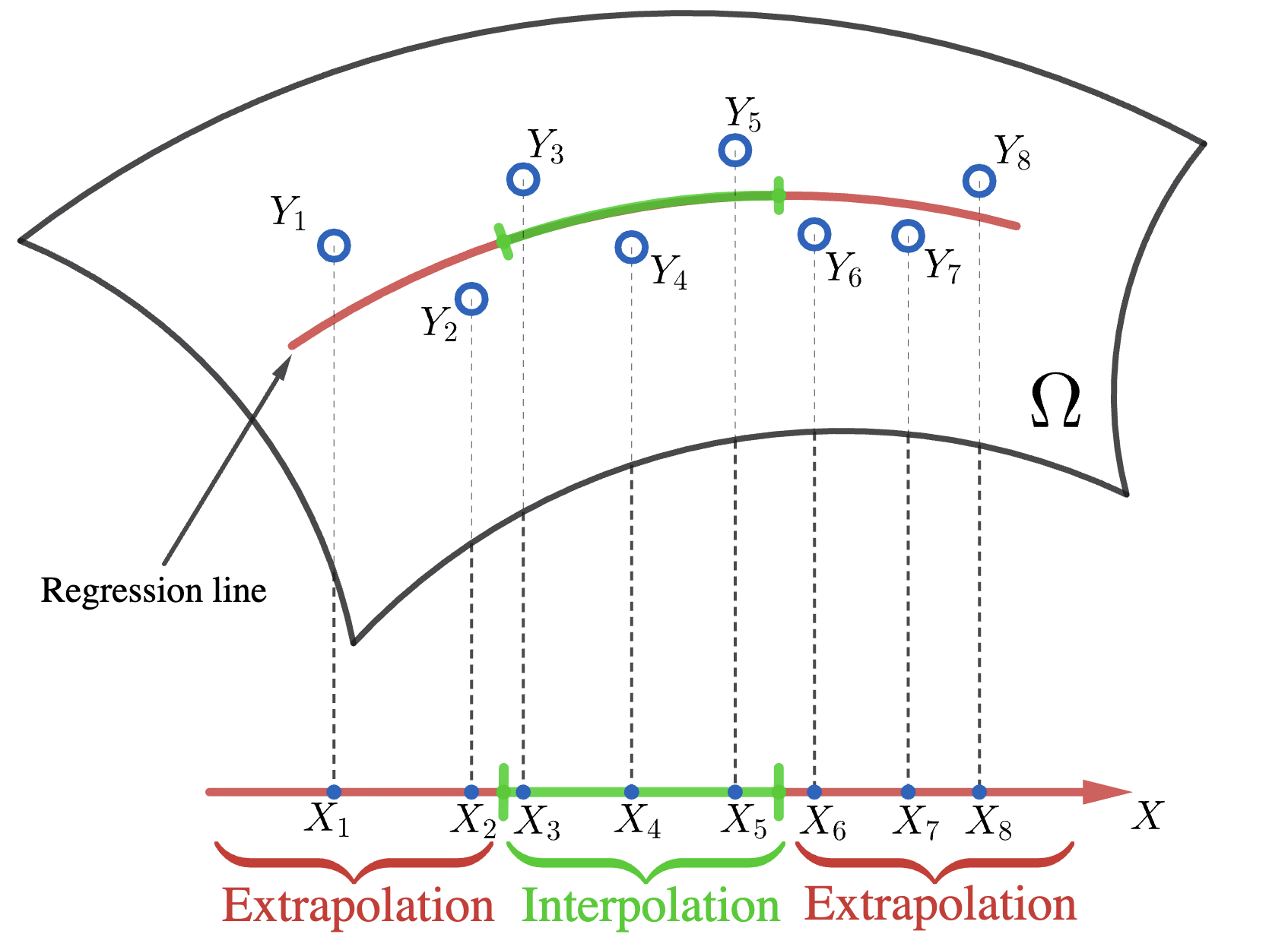
Jun 2026 I will present my paper "Fréchet Regression on the Bures-Wasserstein Manifold" at SIAM Conference on Optimization (OP26) (link).
Apr 2026 New Preprint: "Fréchet Regression on the Bures-Wasserstein Manifold" in arXiv (link).
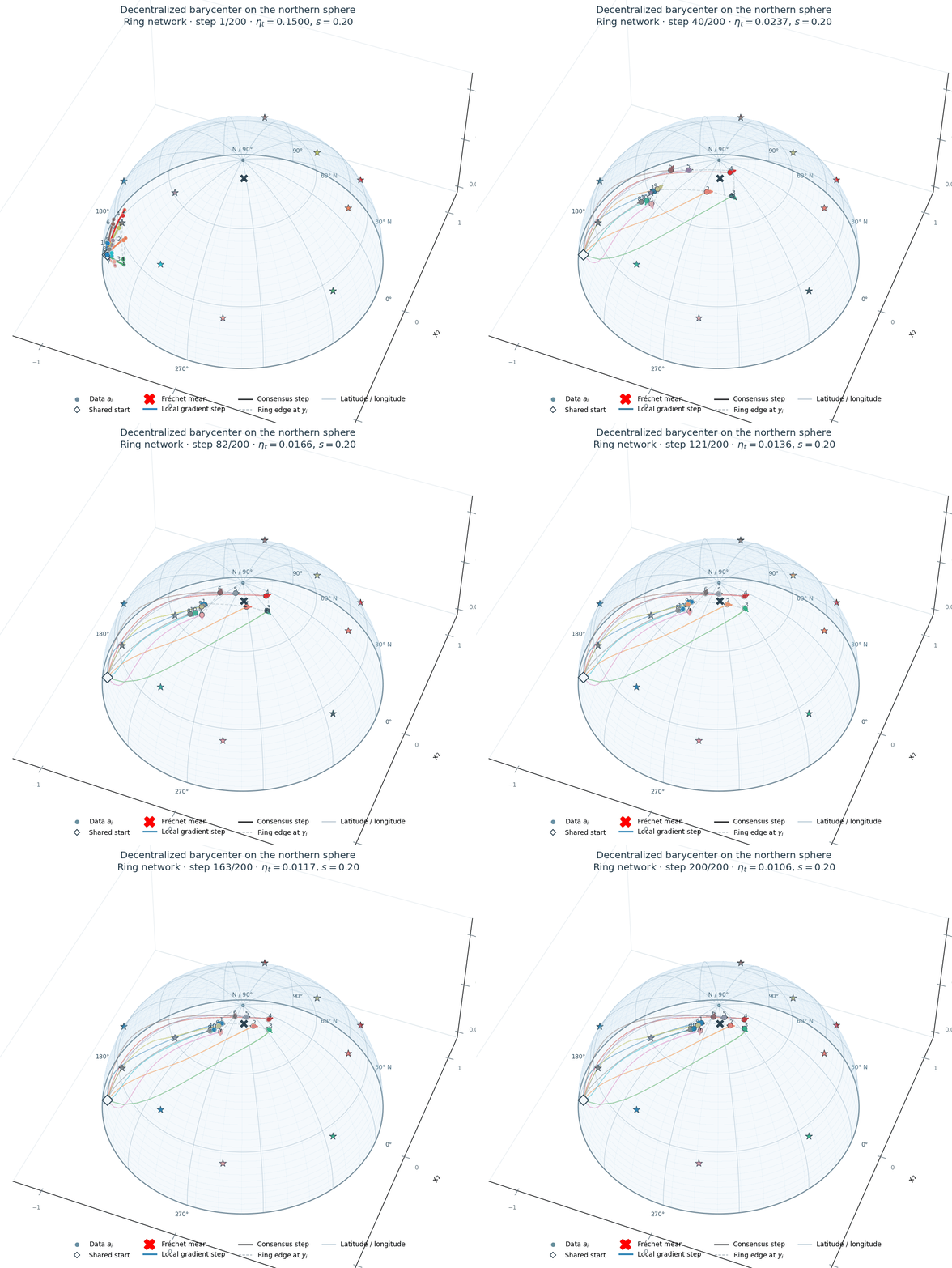
Mar 2026 New Preprint: "Intrinsic Decentralized Stochastic Riemannian Optimization on Manifolds with Bounded Sectional Curvature" in arXiv (link).
Mar 2026 Our work "Fréchet Regression on the Bures-Wasserstein Manifold" is accepted as a Tiny Paper at ICLR 2026 - GRaM Workshop (link).

Projects

Towards Tuning-Free Minimum-Volume Nonnegative Matrix Factorization
(REU STAT-DATASCI 2023, Rice University)

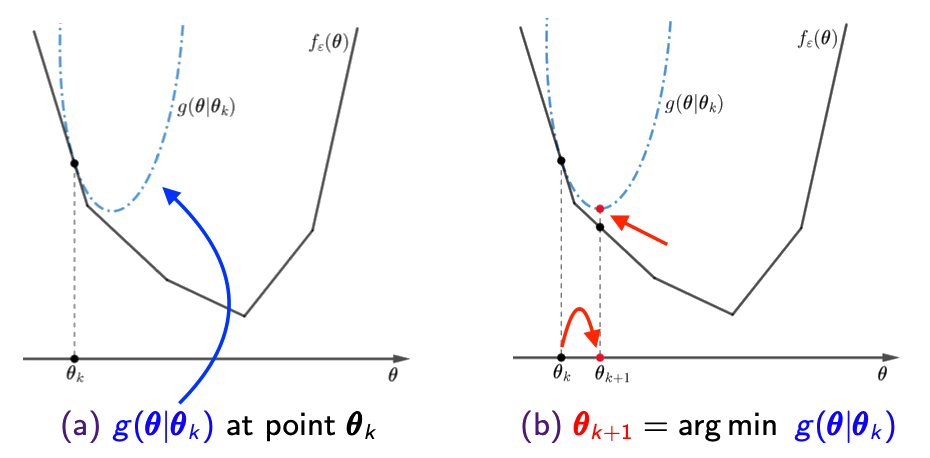
Nonnegative Matrix Factorization (NMF) is a dimensionality reduction technique used in data analysis and machine learning. It aims to decompose a nonnegative matrix as a product of two lower-rank nonnegative matrices. In this project, we implemented and compared multiple minimum-volume NMF algorithms in synthetic and practical data. Also, we applied the Majorization-Minimization idea, a popular paradigm for solving challenging optimization problems. We proposed a new algorithm named Square-Root Minimum-Volume NMF inspired by the Square-Root Lasso problem. Our method improves the previous minimum-volume NMF methods by automatically determining the optimal tuning parameter. I presented this research at the Gulf Coast Undergraduate Research Symposium (GCURS) 2023 and received the Outstanding Session Presentation Award from the Computational Applied Mathematics and Operations Research Department, Rice University. Our paper is published in the Proceedings of the 2024 SIAM International Conference on Data Mining (SDM24). Moreover, I also achieved the SIAM Student Travel Award for the SDM24!

Please visit these links for:
 - The paper.
 - The presentation slides
 - The poster

I worked on this project with Dr. Eric C. Chi under REU STAT-DATASCI 2023 at Rice Department of Statistics.


Shuffling Variance Reduction Stochastic Gradient Optimization

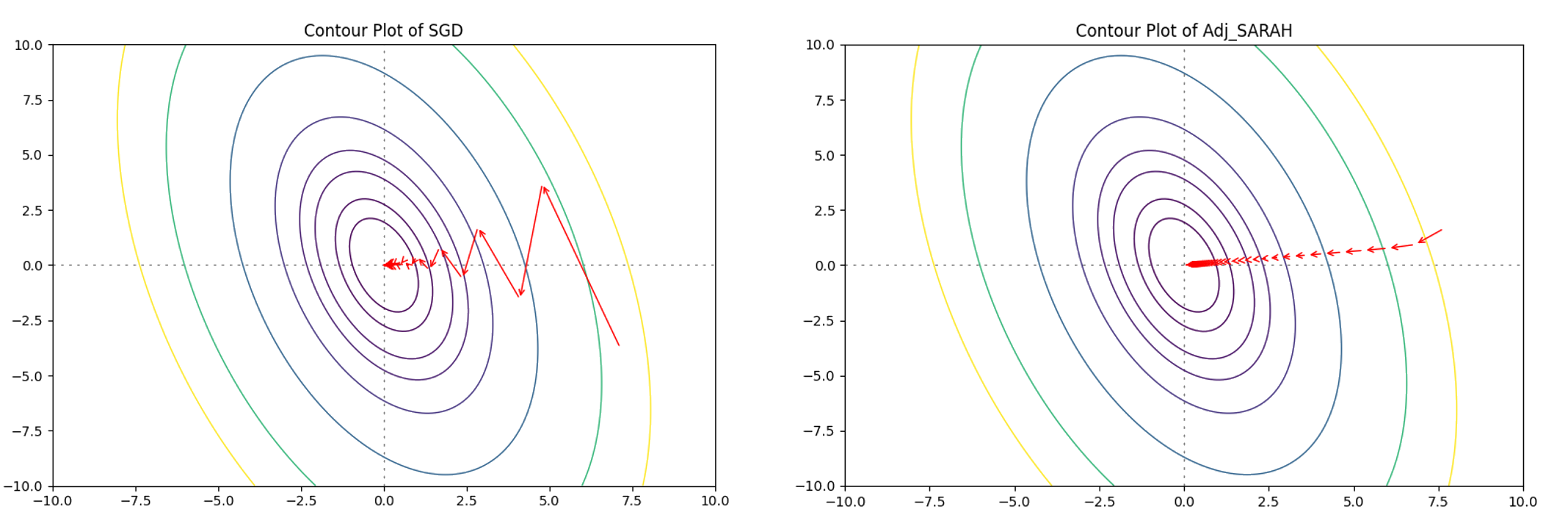
Variance Reduction is an approach in Stochastic Optimization Methods that improves the convergence rate compared to the original Stochastic Gradient Descent (SGD). Intuitively, Variance Reduction methods decrease the variance of the gradient so that the gradient is more direct to the optimal point. Moreover, the shuffling paradigm has recently become a 'hot' topic in the optimization society, and it can improve the rate for SGD in many cases. In this research project, we combine the shuffling paradigm into a famous variance reduction method called SARAH (StochAstic Recursive grAdient algoritHm), analyze its efficiency (convergence rate and complexity), and compare it to other shuffling gradient methods.

I am working on this project with Dr. Lam M. Nguyen (IBM Research) and Dr. Trang H. Tran (Lehigh ISE).


Geodesics Nets - Existence and Construction

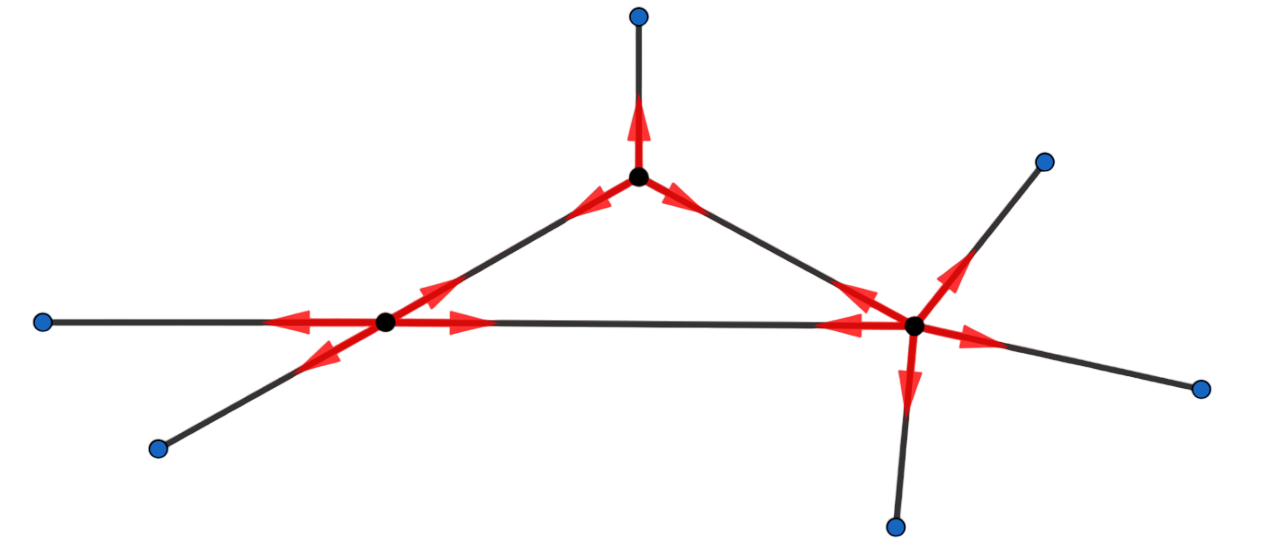
A geodesic net is a network that connects multiple points with the geodesics while ensuring that each additional point is " balanced " and stretched equally by its neighbors through those curves. In this project, we are finding a new algorithm that can construct geodesic nets on different surfaces based on Steiner trees since Steiner trees are satisfied to be geodesic nets. Our algorithm is inspired by the construction of Steiner Tree by bubble soap film, illustrated in the videos below. Moreover, we are finding a condition for the existence of a balanced point in a triangle on a general surface. The investigation is divided into two cases: surfaces with non-positive curvature and surfaces with positive curvature.
 - In the non-positive curvature case, our proof is based on the Gauss-Bonnet theorem.
 - In the positive curvature case, we find a condition for the existence of a balanced point on a general sphere with curvature \(1/R^2\).
Then, we use Jacobi fields (vector fields describing how geodesics "spread") and Rauch comparison theorem to find a general condition on a surface with curvature bounded above by \(1/R^2\) based on the condition on the sphere.

I am working on this project with Dr. Ken Richardson at TCU Department of Mathematics.
Please try our algorithm at https://github.com/ductoanng/BubbleGeodesicNet.


GO2AI

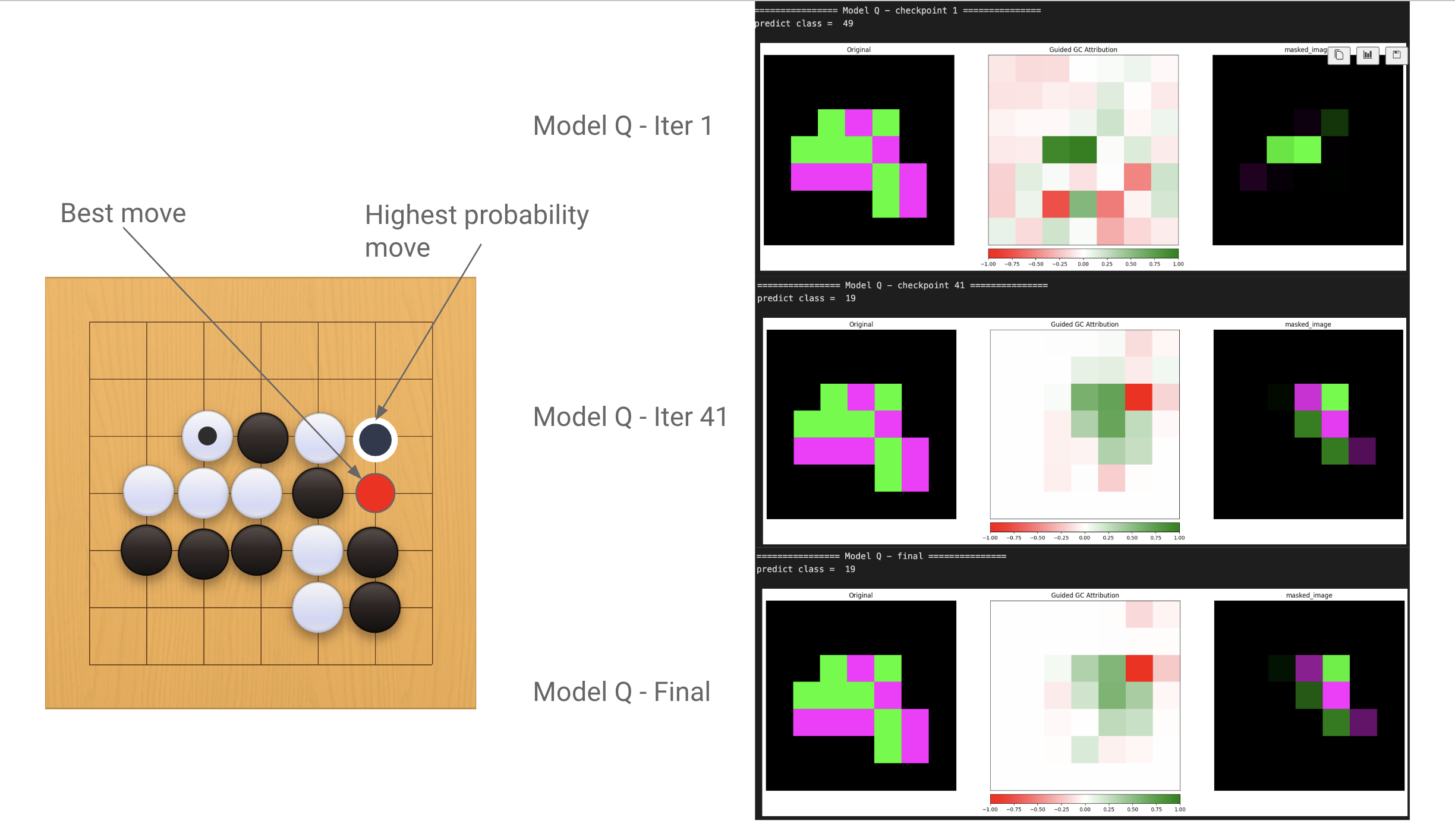
GO2AI is a project working with AI and the game Go to optimize playing. It is inspired by the advent of AlphaGo 2016. In this project, we aim to train AI "slowly" to discover the similarities and differences between AI and human learning processes. We are applying Grad-CAM, an explainable AI method, to understand better how the neural network influences the policy of the AI agent in the decision-making process. The image below shows how the grad-CAM method visualizes how model Q (the AI agent) decides the optimal move from iteration 1 to the final iteration (iter 70). I am part of a dedicated team, including Blake Good, Harrison Leath, Shawn Fahimi, and me, under the supervision of Dr. Liran Ma and Dr. Ze-li Dou at the TCU Department of Computer Science.

Publications

Publications in English

  • Nguyen, D. T. & Uribe, C. A. "Fréchet Regression on the Bures-Wasserstein Manifold." (In Revision for International Conference on Machine Learning - ICML 2026).
  • Nguyen, D. T. & Uribe, C. A. "Intrinsic Decentralized Stochastic Riemannian Optimization on Manifolds with Bounded Sectional Curvature." (Submission for IEEE Control Systems Letters).
  • Nguyen, D. T., Tran, T. H., & Nguyen, L. M. "Adjusted Shuffling SARAH: Advancing complexity analysis via dynamic gradient weighting." (In Revision for Journal of Optimization Theory and Applications - JOTA).
  • Nguyen, D. T. & Chi, E. C. "Towards tuning-free minimum-volume nonnegative matrix factorization." Proceedings of the 2024 SIAM International Conference on Data Mining (SDM24). Society for Industrial and Applied Mathematics, 2024. https://doi.org/10.1137/1.9781611978032.25
  • Nguyen, D. T. "On the existence of a balanced vertex in geodesic nets with three boundary vertices." Journal of Geometry, 116.3 (2025): 36. https://doi.org/10.48550/arXiv.2412.02872
  • Nguyen, D. T.. "Anti-Steiner Point Revisited." Mathematical Reflections. Vol. 2020 and 2021, 30 Sep. 2022, pp. 568–608.
  • Nguyen, D. T. "Geodesic Nets - Construction and Existence." (Outstanding Honors Thesis).

Publications in Vietnamese

  • Nguyen, Duc Toan. “Problems with two tangent homothetic circles.” The mathematical solving methods through Olympiads, 2019.
  • Nguyen, Duc Toan and Van Thanh Son Nguyen. “Solution for Problems from Entrance Exam to Le Quy Don High School For The Gifted, Da Nang city, Vietnam, in 2019.” Vnexpress.net, June 5, 2019.
  • Nguyen, Duc Toan and Van Thanh Son Nguyen. “Solution for Problems from Entrance Exam to Le Quy Don High School For The Gifted, Da Nang city, Vietnam, in 2020.” Vnexpress.net, July 20, 2020.
  • Nguyen, Duc Toan, et al. “Solution for Problems from Entrance Exam to Le Quy Don High School For The Gifted, Da Nang city, Vietnam, in 2021.” Vnexpress.net, June 17, 2021.

Honors/Awards

Presentation

Blog/Podcast

"My Favorite Theorem" math podcast - Episode 84 - The Students of TCU

This spring, I was honored to join the "My Favorite Theorem" mathematics podcast with Dr. Kevin Knudson, Professor and Chair at Department of Mathematics, University of Florida. I was really excited to discuss with him about my favorite theorem, which is "The Mean Value Theorem". We all agreed that it is the "Real" Fundamental Theorem of Calculus. You can find the podcast here .

Duc Toan Nguyen's Plane Geometry Blog

Here is my blog about plane geometry, the field I am really interested when I was in high school. On this site, there are some Olympiad geometry problems I proposed by myself as well as some of my solutions for hard problems. Also, there are some posts about popular topics in Olympiad geometry such as Radical Axis Related Problems.